
Gone Phishing: How to Protect Yourself from AI Scams

Online and mobile banking makes it easy to manage your money from anywhere. Scammers know that, too, and they keep finding new ways to reach people. It’s important to be vigilant, so here’s what you need to know about avoiding scams and protecting yourself and your money.
Scams to Watch For
Phishing Attacks
Phishing can come in the form of emails, text messages, and even phone calls. They’ll have generic greetings, often spelling and grammar errors, and an urgent request asking you to act now. Common scams include a locked account, a failed payment, an unpaid toll, an undelivered package, account verification, or suspicious activity.
Imposter Scams
Imposter scams will pretend to be someone you know to get you to send them money. They may claim to be tech support, a relative, a government official, or even someone you met online. They’ll ask you to use gift cards, wire transfers, cryptocurrency, or payment apps like Venmo or Zelle to send them money. Some scammers may use AI to imitate the voices of loved ones.
“You’ve Won” Scams
Prize, lottery, and sweepstakes scams tell you that you’ve won some sort of prize, but you have to pay a fee for taxes, processing, or shipping before you receive it. Real sweepstakes never require payment to collect winnings, and you can’t win a contest you never entered.
How to Spot a Scam
Urgency, Fear, and Pressure
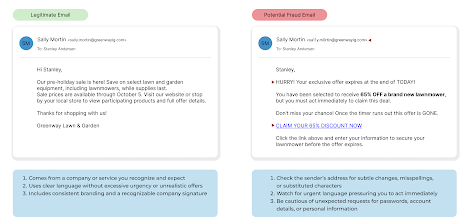
This is the biggest red flag. If an email, message, or phone call wants you to act quickly, it’s probably a scam. Panic and fear can make you act rashly before you can think about the request.
Suspicious Contact
If you weren’t expecting an email or text message from the organization, chances are, it’s a scam. They can also spoof caller ID, making it appear like it’s coming from an organization or loved one. For an email, they may use .com instead of .org or .gov in an email address, or change out one or two letters or numbers for similar ones.
Sometimes copying an address and using a different font can help you recognize the more subtle differences.
Unusual Requests
Be cautious about wire transfers, gift cards, or payment apps because they are difficult to reverse. If someone claims to be a family member in trouble, double check by hanging up and contacting them or another family member directly.
Also look out for any request for your personal information. If they’re really who they say they are, they should already have it.
What Beehive Will Never Ask You For
We will never ask you for personal information through an unsolicited call or text. Caller ID can appear to be Beehive. If you receive a call or message asking for your:
- Member number,
- Username/password,
- Card number,
- Social Security number,
- Date of birth, or
- Security/verification code,
Hang up or delete the text right away and contact us directly at (208) 656-1000.
Pause, Verify, Contact
Our senior information analyst puts it simply:
“Spotting a scam is less about what the actual message looks like, and more about where it comes from and what it’s asking. This external validation is one of your most important tools.”
When you receive an email, message, or call that wants you to act urgently or seems suspicious in any way, slow down and double check:
- Email addresses or phone numbers: Is it the same as on the organization’s website? Look at simple changes, like .com instead of .org or .gov, or anything misspelled.
- Links or attachments: Will it take you to a legitimate website? You can use your mouse to hover over it and double check the link.
- What they’re asking: Does the email ask you to confirm personal information or send money? They may not be who they say they are.
If you’re unsure, don’t reply, click any links, or open attachments. Before you send money, verify that it really is the organization or individual.
Already clicked a link or shared information? Contact us immediately at (208) 656-1000. It happens, and the sooner we know, the sooner we can protect your accounts.
Still Have Questions?
- How can I tell if a call or text from Beehive is legitimate?
- Beehive will never call to ask for personal, account, or card information. This is information we already have as your financial institution. If you’re unsure that it is a Beehive employee, hang up and call us back directly at (208) 656-1000.
- What information will Beehive never ask me to provide?
- Over an unsolicited call, text, or email, we will never ask for your:
- Member number,
- Username/password,
- Card number,
- Social Security number,
- Date of birth, or
- Security/verification code.
- Over an unsolicited call, text, or email, we will never ask for your:
- What should I do if I already gave information or money to a scammer?
- If you have already given information or money to a scammer, you should call us right away at (208) 656-1000. We can freeze your account and disable online banking to protect it from further fraud.
- Can scammers fake or spoof Beehive’s phone number?
- Scammers can spoof caller ID so a call looks like it’s from us. If you get a suspicious call or text message, please hang up and call us directly at (208) 656-1000.
- What is the difference between phishing, smishing, and vishing?
- Phishing, smishing, and vishing are the same concept, but in different forms. Phishing is the general term for the same type of scam, but it’s most often used for scam emails. Smishing is for scam text messages, and vishing refers to scam phone calls.
- Regardless of their form, they will have the same red flags: urgency, suspicious contact, or a request for payment or personal information.
- What are the biggest warning signs that something is a scam?
- Urgency, fear, and pressure are the three biggest warning signs, but always double check the email address or phone number it came from and what they’re asking you to do. If you receive an email, text, or phone call asking for payment or personal information in any way, that should be a red flag.
- What should I do if someone tells me to move money to “protect” my account?
- This is most likely a scam designed to create urgency and panic. If you receive a message like this, you should hang up immediately and call Beehive directly at (208) 656-1000.
- Can scammers use AI to impersonate someone I know?
- With AI becoming more advanced, scammers can use it to impersonate loved ones and acquaintances. This could be through a phone call where they use the person’s voice, or they could generate a message that sounds like it’s from someone you know. You can learn more about it here